

We Predicted the 2026 World Cup Before Kickoff. Here's Our Honest Report Card.
By Dimitar Goshevski · Published: July 22, 2026
Six weeks before the tournament we published our favourites, our dark horses and our live model accuracy — in public, with no way to edit them later. Spain lifted the trophy. Time to grade ourselves, and not just on the calls that make us look good.

The Short Version
In our pre-tournament preview we named Spain our most likely winner. Spain won it — 1–0 against Argentina after extra time in New Jersey on 19 July. That's the headline, and we're happy to shout about it. But our whole pitch is that we publish our accuracy, win or lose. So here's the full card: the picks, the markets, and the team-by-team table — every claim checkable against the public record and against our own live pages.
The Card at a Glance
Four calls that tell you most of the story before we get into the detail.
| What we called | What happened | Verdict |
|---|---|---|
| Spain to win — our most likely champion at ~5.50 (an 18.2% chance) | Spain beat Argentina 1–0 after extra time to lift their second world title | ✓ |
| Spain, England, France, Brazil, Argentina — our top five by odds | Four of the five reached the semi-finals; only Brazil didn't | ✓ |
| The Golden Boot was "a realistic target" for Kylian Mbappé | Mbappé won it, back to back after 2022 | ✓ |
| Brazil ranked fourth on our board — a genuine title contender | Out in the Round of 16, beaten 2–1 by Norway — one of our own dark horses | ✗ |
Our Favourites vs How Far They Actually Got
Each bar in the chart below shows how deep a team went, from the group stage to lifting the trophy, with their rank on our pre-tournament board on the left. If the board was any good, the bars should shrink as you go down. Mostly, they do. One row sticks out like a sore thumb.

The top of the board held up well. Four of our five favourites reached the semi-finals, and the team we put first went all the way. Argentina were the happy surprise — we had the defending champions only fifth, behind England and France, and they answered by beating England in the semis and taking Spain to extra time in the final. Fifth was too low. We'll own that.
And then there's Brazil. Our fourth favourite went out in the Round of 16, beaten 2–1 by Norway with Erling Haaland scoring twice — Brazil's earliest World Cup exit in nearly thirty years. Portugal fell at the same stage, though there's no shame in losing to the eventual champions in what became Ronaldo's farewell. Germany and the Netherlands couldn't even get that far: both were gone in the Round of 32, both on penalties.
The Dark Horses: Two of Six Came Through
Our preview named six teams we felt the bookmakers were sleeping on. Here's the honest tally — two made us look smart, three didn't, and Colombia landed somewhere in between.
Norway — Hit ✓
Quarter-finalists in Haaland's first World Cup — and they got there by knocking out our own #4 favourite, Brazil. If you back a dark horse, this is exactly the chaos you're paying for. England ended their run in the last eight.
Morocco — Hit ✓
Quarter-finalists again, after beating the Netherlands on penalties and then Canada. Not quite the fairy tale of 2022, but once more the last African side standing.
Colombia — Near miss ~
Our "South American wildcard" reached the Round of 16 and went out unbeaten in normal time — 0–0 against Switzerland, losing on penalties, one shootout away from the quarter-finals. Agonisingly close — but a dark-horse pick is about the deep run, and it never quite came. Though hold that thought: Colombia comes back later in this article, in a way we didn't see coming.
Japan — Miss ✗
Got out of a hard group, then lost 2–1 to Brazil in the Round of 32. A decent tournament — just not the deep run we backed them for.
USA — Miss ✗
The hosts got out of their group and reached the Round of 16 — and that's where it ended. Home advantage got them in the door, not through it.
Turkey — Miss ✗
We promised "maximum entertainment, minimum predictability." They chose the second half of that sentence — out in the group stage, and they didn't score in two of their three games.
Norway and Morocco both made the quarter-finals, and Norway ending Brazil's tournament is the kind of call a dark-horse list exists for. Colombia went out unbeaten, on penalties, one shootout from making it three. But the honest score is still two hits from six, and it hides a bigger problem: the two teams that reached the quarters from outside both our favourites and our dark horses — Belgium and Switzerland — weren't on our board at all. We'd even written off Belgium's "aging golden generation." They made the last eight. Several of the teams we actually picked didn't.
Where We Were Wrong
The section most prediction sites quietly delete after the final. Here's ours, on the record.
- Brazil, our #4, crashed in the Round of 16. Beaten 2–1 by Norway. A genuine title contender on our board, gone before the quarters — our biggest wrong call of the tournament.
- We under-rated Argentina. Fifth, behind England and France, was too low for the defending champions. They reached the final. Right team, wrong rank.
- We didn't see Belgium or Switzerland coming. Both reached the quarter-finals; neither was a favourite or a dark horse on our board.
- Three of our six dark horses gave us little back. Turkey went out in the group without scoring in two games, Japan fell in the Round of 32, and the USA went no further than the Round of 16. Colombia we score separately: out in the Round of 16 too, but unbeaten in normal time and one shootout from the quarters — a near miss, not a failure.
Did We Beat the Bookmaker's Own Number?
Being right sometimes is easy — a coin manages it. The real test is whether we were right more often than the odds implied. Each bar below is our published World Cup accuracy for that market; the dashed line is the bookmaker's implied probability. Clear the line and the model added something. Fall short and it didn't — and we show both.
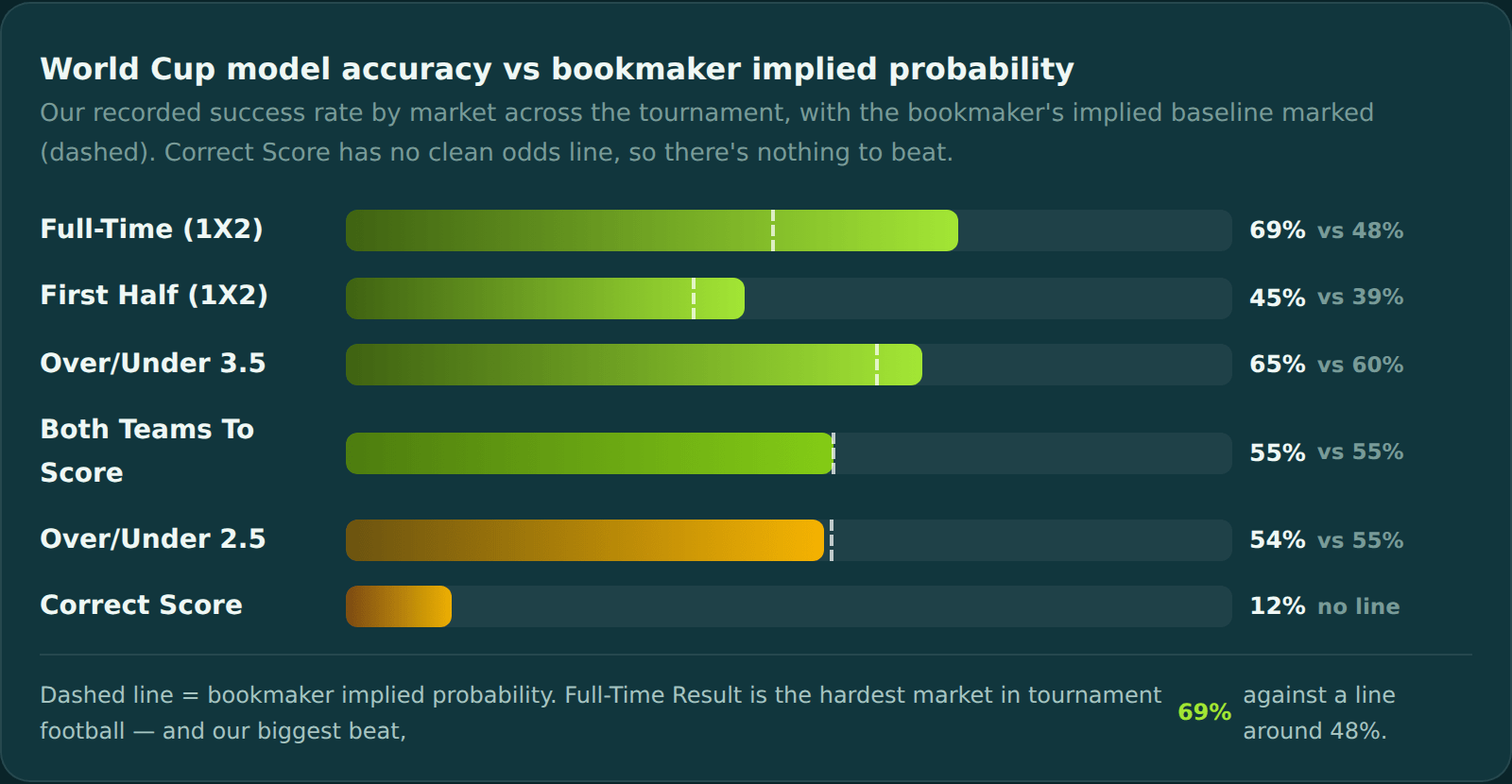
Four of the five markets with a bookmaker line finished above it. Full-Time Result led by a mile, and First Half Result — a market almost nobody talks about — came in nearly six points clear of its line. Over/Under 3.5 edged ahead too.
Now the ones that didn't add much, because they matter too. Both goal markets landed right around the bookmaker's line: both teams to score at 55%, a whisker above a roughly 55% line, and over/under 2.5 at 54%, a whisker below it — no real edge either way. Our preview talked the goals markets up, and over one tournament they matched the book rather than beating it; there's no dressing that up. As for Correct Score at 12% — that's your annual reminder that picking an exact scoreline is close to a lottery, whoever's doing the picking.
The Team-by-Team Table: Where the Model Earned It, and Where It Got Embarrassed
This is the part we're most proud of, and the part that hurts the most — because it grades everything. Throughout the tournament our World Cup page scored the 48 teams on three markets — match result (1X2), both teams to score, and over/under 2.5 goals — game by game, with a green or red dot for every call. One thing to know before you read it: the table grades up to each team's last five World Cup games (fewer if they played fewer), so for the finalists — who played eight games — it reflects their last five, not the whole run. Here's what it says now the confetti's been swept up.

We Read the Outsiders Better Than the Favourites
Here's the humbling pattern: the teams the model read best weren't the ones everybody watched. Senegal and Côte d'Ivoire topped the table, both graded 11 out of 12 — a perfect four from four on match result and four from four on both-teams-to-score. Right behind them, South Korea and Jordan at eight from nine. And the one that doubles as a story: Norway at 13 from 15, the dark horse we backed to run deep, who knocked Brazil out and whom the model read almost flawlessly — a perfect five from five on both-teams-to-score. We were right about how these sides played, game after game. The favourites were a different matter.
Market by Market: Who We Nailed, Who Kept Beating Us
Match result (1X2) was the table's strong suit: of the 48 teams, we were above 50% on 34, exactly on 50% for 6, and below on just 8. Twelve teams we called perfectly — Spain, the USA and Mexico among them, alongside Côte d'Ivoire, Senegal, Croatia and Iraq. Only one team beat us clean: Iran, 0 from 3 — every result a surprise.
Both teams to score was a coin-flip: 23 teams above 50%, 4 exactly on it, 21 below — a near-even split that mirrors the market's dead-level tournament number. Norway were flawless at five from five, with Côte d'Ivoire, Senegal, South Korea, South Africa, Algeria and the Czechs all perfect too. At the bottom, Bosnia went 0 from 4 — we never once called whether both sides would score in a Bosnia game.
Over/under 2.5 was steadier than its reputation — 28 teams above 50%, 3 exactly, 17 below. South Africa and Ghana went a perfect four from four, South Korea and Jordan three from three. The rough end was rougher, though: five teams went 0 from 3 — Iraq, Curaçao, Scotland, Haiti and Uzbekistan — each a clean sweep of misses on total goals.
The Champions: Every Result Right, the Goals a Mystery
Here's the one that keeps us honest. Spain — the team we picked to win the whole thing — we called perfectly on results across their last five games: five from five. The goals were another story: one from five on both-teams-to-score, two from five on over/under 2.5. We knew who would win; we had no idea how many goals it would take. Champions do that — they win ugly, rest players, do just enough. The model read Spain's results better than almost anyone's, and their goal markets worse than most.
The rest of the big names, for the record: France and Switzerland both graded 80% on match result (four from five) — and Switzerland is the sting, because we completely failed to flag them as a quarter-finalist, yet once the games kicked off the model read their results better than most. Germany came in middling at 50% on results, and Brazil — our number-four pick, out in the Round of 16 — we read at three from five, no better than average. The model's real blind spots were smaller sides: Iran (0 from 3 on results), Bosnia (0 from 4 on both-teams-to-score) and Australia (25% across the board). Every model has a nemesis; ours wore several shirts.
 Côte d'Ivoire
 Senegal
 Korea Republic
 Jordan
 Norway
 South Africa
 Algeria
 Mexico
 Czech Republic
 Sweden
 Croatia
 United States
 Belgium
 Ecuador
 Netherlands
 Tunisia
 Austria
 Ghana
Ghana Switzerland
 Canada
 Paraguay
 France
 England
 New Zealand
 Saudi Arabia
 Iraq
Iraq Spain
Spain Argentina
 Colombia
 Germany
 Japan
Japan Congo DR
 Brazil
 Morocco
 Portugal
 Curacao
 Qatar
Qatar Scotland
 Haiti
Haiti Uruguay
 Uzbekistan
 Panama
 Cape Verde Islands
 Egypt
Egypt Bosnia and Herzegovina
 Australia
 Iran
Iran TurkeyCôte d'IvoireSenegalKorea RepublicJordanNorwaySouth AfricaAlgeriaMexicoCzech RepublicSwedenCroatiaUnited StatesBelgiumEcuadorNetherlandsTunisiaAustriaGhanaSwitzerlandCanadaParaguayFranceEnglandNew ZealandSaudi ArabiaIraqSpainArgentinaColombiaGermanyJapanCongo DRBrazilMoroccoPortugalCuracaoQatarScotlandHaitiUruguayUzbekistanPanamaCape Verde IslandsEgyptBosnia and HerzegovinaAustraliaIranTurkeyCôte d'IvoireSenegalKorea RepublicJordanNorwaySouth AfricaAlgeriaMexicoCzech RepublicSwedenCroatiaUnited StatesBelgiumEcuadorNetherlandsTunisiaAustriaGhanaSwitzerlandCanadaParaguayFranceEnglandNew ZealandSaudi ArabiaIraqSpainArgentinaColombiaGermanyJapanCongo DRBrazilMoroccoPortugalCuracaoQatarScotlandHaitiUruguayUzbekistanPanamaCape Verde IslandsEgyptBosnia and HerzegovinaAustraliaIranTurkey
The Honest Caveat
One World Cup is a small sample — 104 matches, only a handful per team. It was also a chalk-heavy edition: all four semi-finalists — Spain, England, France and Argentina — were top-five picks on our board, which flatters a result-picking model more than a chaotic tournament would. And the per-team table is a harsher lens than the market averages above, because it grades only each side's last five games (or fewer) and forgets nothing. A 69% tournament on match results is a genuinely strong run, not a promise. The number that matters is the one we keep publishing, live, across every league, long after the confetti's gone.
The Verdict
Grading ourselves the way we'd grade anyone else: we got the biggest call right — Spain, picked first, champions. Four of our top five made the semis, we flagged Mbappé's Golden Boot, and our best dark horse ended a favourite's tournament. Against that: we under-ranked the eventual finalists, whiffed completely on Brazil's exit, missed Belgium and Switzerland altogether, and one of the goals markets we'd talked up finished just under the bookmaker's line. The team table cuts both ways too — the model read the outsiders best (Senegal and Côte d'Ivoire perfect at the top), called all five of the champions' graded results but none of their goal markets, and had a genuine blind spot in Iran, whose results it got 0 from 3.
None of this makes anyone rich, and no model calls a Ferran Torres extra-time winner. But every number on this page was written down before kickoff and settled against the real result — which, as far as we're concerned, is the only kind of prediction worth publishing.
Frequently Asked Questions
Did AI predict Spain to win the 2026 World Cup?
Yes. Six weeks before kickoff, our pre-tournament preview named Spain the most likely winner at odds of about 5.50 — an 18.2% implied chance. Spain beat Argentina 1–0 after extra time in the final on 19 July 2026. An 18.2% chance also means we expected to be wrong four times out of five, so we treat it as a well-calibrated call rather than a prophecy.
How accurate were the AI predictions at the 2026 World Cup?
Our published match result (1X2) accuracy for the tournament was 69%, against a bookmaker implied probability of about 48%. First Half Result hit 45% against a 39% line and Over/Under 3.5 goals hit 65% against 60%. Both Teams To Score matched its line at 55%, and Over/Under 2.5 finished just below it at 54%. Every figure is published live on our World Cup page.
Did the model beat the bookmakers at the World Cup?
On four of the five markets with a bookmaker line, yes — most clearly on Full-Time Result. On Over/Under 2.5 goals it finished just under the line, and Both Teams To Score was level with it, which we report just as openly. Beating the implied probability over a full tournament is the test that matters, not being right on any single game.
Which team was hardest to predict?
On the team-by-team table the model's clearest blind spot was Iran — 0 from 3 on match results, every outcome a surprise. Bosnia were hardest on both-teams-to-score (0 from 4), and a cluster of sides — Turkey, Iran, Bosnia and Australia — graded lowest overall at around 33% across the three markets. Among the favourites, champions Spain were the split case: perfect on results (five from five) but hard to read on goals.
Where can I see these predictions being tracked live?
The full team-by-team World Cup table — every green and red dot, for all 48 teams across three markets — is on our World Cup 2026 predictions page. The same live grading runs year-round for every league we cover, and nothing is edited or reset after results settle.
About this data
Data refreshes hourly as match results settle.
Past performance doesn't guarantee future results. Use the data to inform your decisions, not replace them.